Wondering if a Contra Costa County home could help offset your housing costs? That idea is driving more buyers to look beyond the standard single-family layout and think about rental income, flexible living space, and renovation potential. If you want to understand what house hacking can really look like in this county, and where the opportunities and limits are, this guide will walk you through the practical paths. Let’s dive in.
What house hacking means here
In Contra Costa County, house hacking usually means buying or using a home you live in while creating some form of long-term rental income from the property. That could mean renting out a bedroom, converting part of the home into a junior accessory dwelling unit, building or converting an accessory dwelling unit, or legalizing an older in-law-style space.
The key is that the strategy needs to match the property, the permit path, and your financing. In this county, the most realistic house hacking plans are owner-occupied and focused on long-term rentals, not short-term stays.
Why Contra Costa County stands out
Contra Costa County offers several workable ways to create rental income from a primary residence, but the rules matter. The county says ADUs require planning approval and building permits, whether you are building a new unit or trying to legalize an older one.
The county also makes clear that ADUs are not allowed for short-term rental use. If you are evaluating a home for income potential, that means your plan should center on stable, longer-term occupancy.
Room rentals: the simplest entry point
For many buyers, renting out a bedroom or taking in a boarder is the most accessible way to house hack. You may not need major construction, and you can often start with the home as it already exists.
This approach can be especially appealing if you want lower upfront costs and more flexibility. You live in the property, keep control of the main home, and generate income from unused space.
Why room rentals appeal to first-time house hackers
Room rentals usually involve less permitting complexity than adding a separate unit. They can also give you a way to test whether shared-property living fits your goals before committing to a construction project.
From a financing standpoint, documented boarder or roommate income may help in some cases. The important part is documentation, since lender and underwriting standards can be stricter than what zoning allows.
What lenders may look for
Guidance cited in the research shows that income from roommates or boarders in an owner-occupied single-family home can be acceptable if it is properly documented. Tax returns, rental history, and other file documentation may matter.
That does not mean every lender will treat the income the same way. A property may support a room-rental strategy in real life, but your loan approval will still depend on how the lender underwrites the file.
JADUs: small conversion, specific rules
A junior accessory dwelling unit, or JADU, can be a smart option if you want to carve out a smaller living area within the existing home. Contra Costa County says a JADU is capped at 500 square feet and is limited to single-family residential districts.
For some homeowners, a JADU can be a lower-cost way to create separate living space without building a full detached unit. It can work well when the layout of the existing home already supports a partial conversion.
Key JADU rules to know
JADUs come with more specific limits than standard ADUs. State guidance referenced in the research says a JADU can trigger owner-occupancy requirements when sanitation is shared with the main home.
The county also notes that any rented JADU must be rented for longer than 30 days. So if your plan is based on vacation-style use, a JADU is not the right fit in Contra Costa County.
ADUs: the most flexible house hacking option
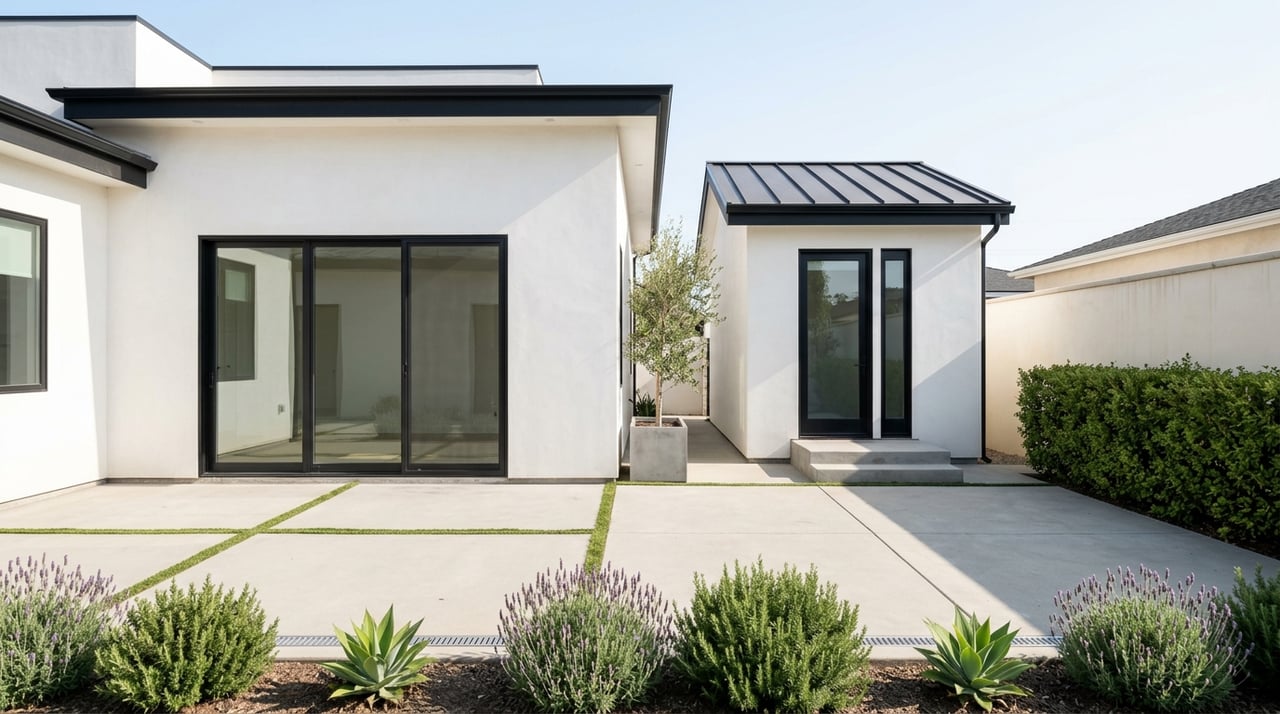
A standard ADU usually gives you the clearest separation between your living space and your rental space. Research cited from Fannie Mae and Freddie Mac notes that ADUs can be within the main home, attached to it, or detached on the same lot.
That flexibility matters because house hacking is rarely one-size-fits-all. Some homes work best with a garage conversion, some with an addition, and some with a detached backyard unit.
Common ADU paths
Here are the most practical ADU approaches for Contra Costa County buyers and owners:
- Internal conversion of existing space within the home
- Attached addition that expands the main structure
- Detached ADU in the backyard
- Garage, attic, or basement conversion where layout and code requirements allow
Each option has a different cost profile, timeline, and permitting complexity. The right choice often depends on lot layout, utilities, privacy, and how much separation you want from your tenant.
Detached ADUs may be easier than expected
Contra Costa County highlights streamlined processing for detached ADUs up to 800 square feet and 16 feet in height. The county also says those units are not subject to parking requirements.
That can make detached ADUs more attractive than many buyers assume. If parking has been one of your biggest concerns, it may not be the obstacle you thought it was.
Legalizing an older unit can create value
If you are looking at a property with an older in-law unit or garage conversion, do not assume it is automatically unusable. Contra Costa County says pre-2020 ADUs or JADUs may be legalized without late filing fees or penalty fees, subject to permit review and code compliance.
That can be important for buyers trying to compare homes with existing conversion potential. In some cases, an older unpermitted unit may represent future income potential, but only if it can be brought through the proper process.
Why legalization matters during a purchase
A seller may describe a space as an in-law unit, guest area, or converted garage, but the real question is whether the unit has permits or can be legalized. That distinction can affect financing, appraisal, renovation cost, and your timeline after closing.
This is where a renovation-aware review becomes valuable. A property with an older unit may be promising, but you want a realistic understanding of code upgrades, permit steps, and likely costs before you commit.
Permitting realities in Contra Costa County
House hacking plans tend to look easy on paper and more complex once permitting starts. In Contra Costa County, ADUs require both planning approval and building permits, and the same process applies whether you are building new or legalizing an existing unit.
Even if you use a preapproved ADU plan, the county says you still need site-specific planning review. Depending on the property, you may also need input from Planning Staff, Building Permit Staff, or Environmental Health.
City and county coordination can matter
If the property is in Clayton, Hercules, Lafayette, Orinda, or Moraga, the county says planning approval must come from the city before the building permit is submitted to the county. That added layer can affect your timeline.
If the parcel uses septic, Environmental Health review is also needed. For some buyers, that single issue can reshape the feasibility of a conversion.
Conversions can trigger upgrades
Garage, attic, basement, and similar conversions may require fire-rated separation and upgrades to air, thermal, or moisture barriers. These are not minor details because they can materially change your renovation budget.
This is one reason house hacking works best when you look at both income potential and construction reality at the same time. The cheapest-looking conversion is not always the most efficient one once code work is included.
Financing takes more than a good idea
A workable house hacking strategy still has to fit lender rules. Research cited here shows that ADUs can be financed through standard purchase or refinance loans, renovation financing, or construction-to-permanent financing, depending on the scenario.
Fannie Mae and Freddie Mac also indicate that ADU rental income may help with qualifying when the file meets their requirements. But that does not mean every projected rent number will count the way you hope.
Documentation is the difference
Lenders often want rental income to be supported by the appraisal, rent documentation, or tax history, depending on the loan structure. For room-rental setups, boarder income also depends on the documentation in the file.
In simple terms, zoning may say you can build or rent a unit, but your lender may still apply narrower standards. If you are buying with a house hacking plan in mind, it helps to think about permits, layout, and underwriting all at once.
Taxes and recordkeeping matter too
Rental income is generally taxable, and many rental expenses may be deductible. If your property is used partly for personal living and partly as a rental, records need to clearly separate those uses.
That is one more reason to keep your setup organized from the start. Clear leases, payment records, and expense tracking can make ownership much easier over time.
A practical way to evaluate a house hacking property
If you are comparing homes in Contra Costa County, try looking at each one through four lenses:
- Property fit: Is there space for a room rental, JADU, ADU, or legalization path?
- Permit fit: What approvals, reviews, or upgrades will likely be required?
- Financing fit: Will your lender recognize any projected rental income?
- Lifestyle fit: How much privacy, construction disruption, and landlord responsibility are you comfortable with?
The strongest house hacking opportunities usually work across all four. A property is not automatically a good candidate just because it has a large lot or an older converted space.
Who benefits most from house hacking
House hacking can make sense for buyers who want to lower monthly carrying costs, build long-term flexibility, or create extra space for changing household needs. It can also appeal to buyers who are comfortable managing a renovation and want a property with value-add potential.
In Contra Costa County, the best opportunities are often homes where the layout already supports a clean conversion path. That is especially true when you want to keep risk, cost surprises, and timeline issues under control.
Bottom line for Contra Costa County buyers
House hacking in Contra Costa County is absolutely possible, but it works best when you stay grounded in the local rules. Room rentals, JADUs, ADUs, and legalization of older units can all be viable paths, but each comes with different limits around permits, occupancy, construction, and financing.
If you approach the process with a realistic plan, the right property can do more than give you a place to live. It can give you income, flexibility, and a smarter long-term ownership strategy.
If you are exploring properties with rental or conversion potential in Contra Costa County, Perry Kayasone can help you evaluate the layout, renovation path, and real-world tradeoffs before you make a move.
FAQs
Can I rent out an ADU in Contra Costa County?
- Yes, if the ADU is properly approved and used within local rules. Contra Costa County does not allow ADUs to be used as short-term rentals.
Can I use a Contra Costa County ADU for Airbnb-style rentals?
- No. The county says ADUs are not allowed for short-term rental use, and JADUs must be rented for longer than 30 days.
Can a JADU work for house hacking in Contra Costa County?
- Yes, a JADU can work if the property is in a single-family residential district and the project meets county and state rules, including size and occupancy requirements.
Do I need parking for an ADU in Contra Costa County?
- Often not in the county’s streamlined detached ADU category. State guidance also limits how much parking can be required for ADUs.
Do I have to live on the property if I build an ADU in Contra Costa County?
- Not for a standard ADU under current state guidance cited in the research. A JADU can involve owner-occupancy requirements when sanitation is shared with the main home.
Can I legalize an older in-law unit in Contra Costa County?
- Possibly. The county says pre-2020 ADUs or JADUs may be legalized without late filing fees or penalty fees, subject to permit review and code compliance.
Can rental income help me qualify for a Contra Costa County house hacking purchase?
- In some cases, yes. ADU or boarder income may help with qualifying when lender documentation and underwriting requirements are met.
What is the biggest risk with converting a garage or basement in Contra Costa County?
- A common issue is underestimating required code upgrades, including fire-rated separation and air, thermal, or moisture barrier work, along with any septic or permit-related review.